
Under the radar in siRNA therapeutics
Nucleic Acid Insights 2026; 3(4), 277–293
DOI: 10.18609/nai.2026.034
The clinical success of siRNA therapeutics has advanced more rapidly than our mechanistic understanding of the processes that determine their activity, safety, and durability. Across multiple delivery platforms, tissue exposure alone is often a poor predictor of productive silencing. Simple seed-based models incompletely explain toxicity risk, and RISC persistence does not fully account for the prolonged pharmacodynamic effects observed in vivo. In this perspective, we examine how these gaps emerge from three interconnected areas of siRNA biology: intracellular trafficking, off-target activity, and duration of effect. We discuss evidence that endosomal routing and escape remain major determinants of efficacy. We discuss evidence that toxicity arises from a broader set of mechanisms than canonical seed matching alone. We discuss evidence that long-lasting target suppression is likely driven by a combination of chemical stability, intracellular reservoirs, ongoing RISC generation, and target turnover kinetics. Collectively, these observations argue for a more quantitative and mechanistic framework for understanding siRNA pharmacology, one that integrates delivery, intracellular fate, and hybridization biology to guide the design of next-generation therapeutics.
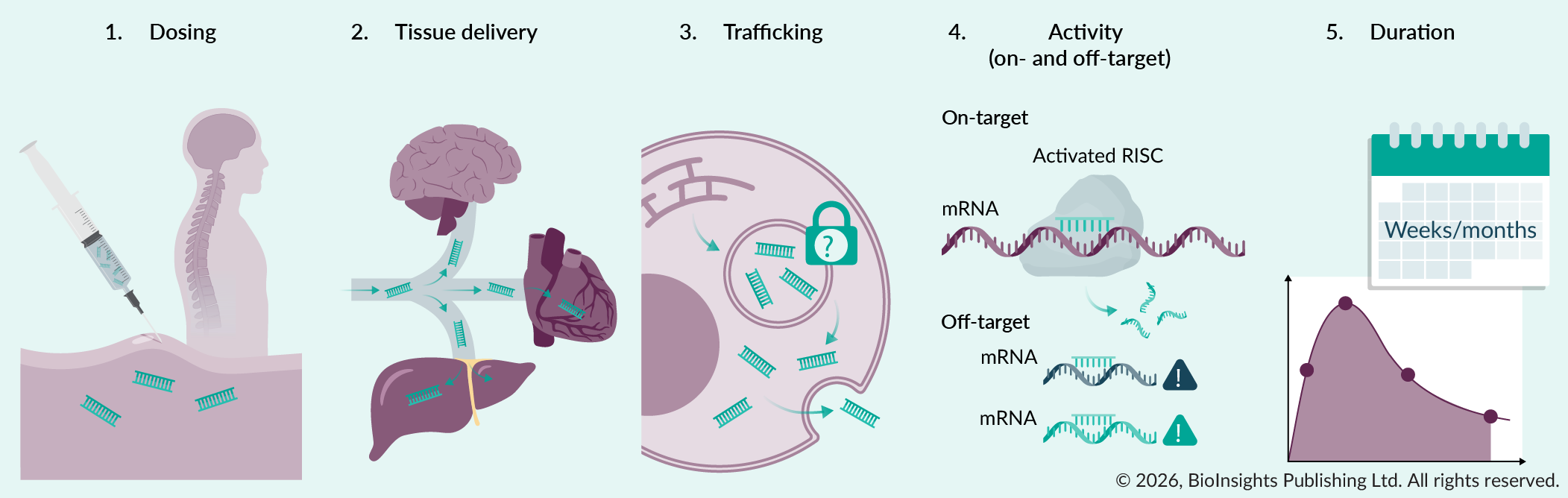 |
| Graphical abstract. Under the radar in siRNA therapeutics. © 2026, BioInsights Publishing Ltd. All rights reserved. |